
Straight Modular Conveyors
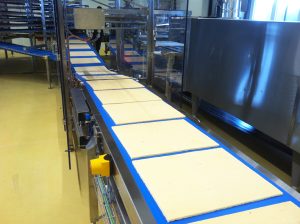
Straight modular conveyors are robust and versatile transport systems designed for controlled product movement along a linear path. They are widely used in food-processing and industrial applications where reliable operation, hygienic design, and layout flexibility are required.
The conveyor consists of three main sections: a drive section, a conveying (middle) section, and a return section. The modular belt is driven by a motorized shaft with sprockets, ensuring stable belt tracking and consistent product flow.
Modular Belt Design
The belt is assembled from interlinked modular elements and can be manufactured from various food-grade plastic materials, selected according to product type, load, temperature, and operating environment. This design provides high mechanical strength and resistance to wear.
Performance and Integration
Straight modular conveyors are suitable for transporting heavy loads, products with sharp edges, and items exposed to liquids, chemicals, or elevated temperatures. They can be seamlessly combined with curved, inclined, or spiral sections to create complex conveying layouts tailored to production requirements.
Hygienic and Operational Benefits
The open belt structure and accessible frame design support effective cleaning and inspection, making these conveyors suitable for hygienic food-production environments. Modular construction simplifies installation, maintenance, and belt replacement, ensuring long service life and minimal downtime.
Straight modular conveyors provide a reliable and efficient solution for linear product transport while offering the flexibility needed for modern food-processing lines.
Conveyor Control Systems
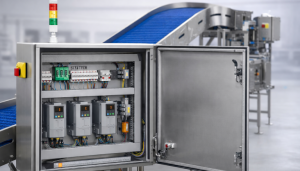
The control systems of our conveyor equipment are designed to ensure stable, reliable operation and full compliance with current electrical safety standards. All systems are engineered in accordance with applicable EU regulations and industrial safety requirements.
Depending on customer requirements, we offer several control system configurations that differ in functionality, level of automation, and investment cost.
Control System Architecture
Modern conveyor control systems are typically based on:
-
Industrial PLC platforms
-
Frequency converters (VFDs) for smooth speed control and energy efficiency
-
Decentralized or centralized I/O architectures, depending on system complexity
The control logic ensures synchronized operation of conveyor sections, controlled start/stop sequences, and protection against overloads and abnormal operating conditions.
Safety and Compliance
Control systems can be equipped with:
-
Emergency stop circuits
-
Safety relays or safety PLCs
-
Motor protection and fault monitoring
This supports compliance with electrical safety standards and safe operation in food-processing environments.
Functionality and Options
Depending on the application, the control system may include:
-
Speed regulation and process synchronization
-
Line start/stop and zone control
-
Integration with upstream and downstream equipment
-
Interface with higher-level production or packaging systems
-
Diagnostic and fault indication for simplified maintenance
Customization
Control schemes are selected and configured according to:
-
Conveyor layout and number of drives
-
Required level of automation
-
Integration into existing production lines
-
Customer budget and operational preferences
Our approach allows customers to choose between basic, cost-effective solutions and advanced automated systems, while maintaining high reliability, safety, and long-term serviceability.