
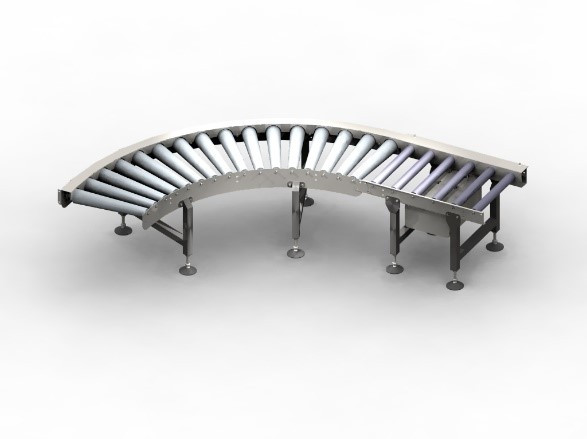
Roller Conveyors
Roller conveyors are mechanical conveying systems consisting of a series of rollers with fixed axes, mounted at defined intervals on a common frame. They are designed for the transport of products with rigid bases, such as pallets, corrugated cartons, trays, and similar unit loads.
Due to their simplicity, flexibility, and cost efficiency, roller conveyors are widely used across many industries and form an essential part of modern conveyor systems.
Types of Roller Conveyors
Depending on application requirements and layout constraints, roller conveyors can be configured as:
-
Non-driven (gravity) or driven
-
Straight or curved
-
Stationary or mobile
-
Horizontal or inclined
-
Flexible gravity conveyors
-
Infeed and outfeed conveyors
-
Accumulation roller conveyors
To ensure correct product guidance and safe operation, roller conveyors can be equipped with side guides, boards, stops, and automation components.
Design Principles
The roller width is typically selected slightly smaller than the width of the transported product to ensure stable movement. The distance between adjacent rollers is defined so that at least three rollers support the product at all times; for small products, the roller pitch is generally less than one-third of the product length.
Roller material, bearing type, and frame construction are selected based on operating conditions, load characteristics, hygiene requirements, and system layout. These parameters also influence the overall cost of the conveyor.
Gravity (Non-Driven) Roller Conveyors
Non-driven roller conveyors, also known as gravity conveyors, are installed with a slight incline in the direction of product movement. Product transport is achieved by gravitational force, causing the rollers to rotate as the load moves along the conveyor.
Gravity roller conveyors are a cost-effective solution for simple transport, accumulation, and buffer zones.
Driven Roller Conveyors
Driven roller conveyors allow controlled product movement along defined paths and can transport loads on inclines of up to approximately 5 degrees. Power transmission from the drive motor to the rollers is achieved through systems such as chain drives or belt drives.
These conveyors feature simple construction, easy installation, and reliable operation, making them suitable for warehouses, packaging lines, and production environments.
Technical Characteristics and Configuration
The configuration of a roller conveyor depends on:
-
Product properties (dimensions, weight, base rigidity)
-
Sanitary and hygiene requirements
-
Environmental conditions (temperature, humidity, dust)
-
Safety and operational requirements
An optimal combination of roller type, frame material, and accessories is selected to meet performance requirements while minimizing investment and operating costs.
Roller and Frame Materials
Roller materials:
-
Galvanized steel
-
Stainless steel
-
PVC
-
Galvanized steel with rubber coating
Frame materials:
-
Structural steel with powder coating
-
Galvanized steel
-
Stainless steel
-
Aluminum profiles
Side guides and boards:
-
Sheet-metal boards (various materials)
-
Bar-type guides
-
High-molecular-weight plastic profiles
Reliability and Maintenance
Roller bearings are lubricated for the entire service life and require no regular maintenance. Transmission elements are maintenance-free, and the design contains no critical wear parts. Bearings can be specified for operation in low-temperature environments, including freezer applications.
Roller conveyors combine low operating costs, high reliability, and robust performance, making them an effective solution where other conveyor types are impractical or economically unjustified.