
Spiral conveyors
Engineered Vertical Transport for Food Processing and Industrial Lines
Baltic Conveyor Systems designs and manufactures custom spiral conveyors for food production and industrial processing facilities across Europe and internationally.
Spiral conveyors are space-efficient vertical conveying systems developed to transport products upward or downward while maintaining stable throughput within a minimal footprint. They are widely used where floor space is limited but controlled and continuous product flow is required.
Each spiral conveyor is engineered according to your production layout, throughput and process requirements.
Mechanical Concept and Drive Configuration
A spiral conveyor consists of:
- A central drive drum
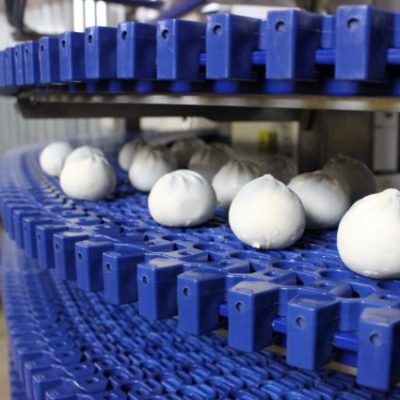
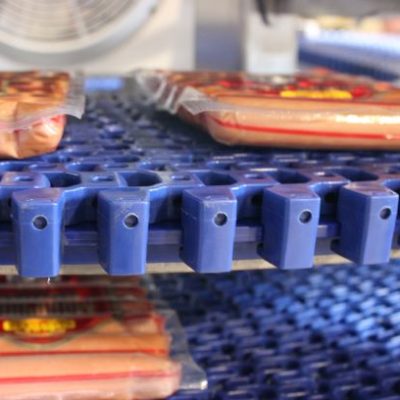
- A modular or wire mesh belt spiraling around the drum
- Guided support profiles along the spiral path
- A return section for continuous belt circulation
After reaching the lowest point of the drum, the belt returns through a dedicated return section to the start of the spiral, ensuring uninterrupted operation.
Drive System Options
Depending on load, belt type, and operating conditions, the spiral drive can be implemented as:
- Direct connection of the drum shaft to the hollow shaft geared motor
- Chain transmission between the drum shaft and the motor
The selected drive configuration is determined by:
- Spiral diameter
- Number of tiers
- Product weight and distribution
- Required torque
- Environmental conditions
Drive systems are dimensioned for long-term mechanical stability and predictable operation.
Engineering Parameters and Design Flexibility
Every spiral conveyor is individually calculated and designed.
The engineering process is based on:
- Production area layout
- Environmental and hygienic conditions
- Required construction materials
- Product dwell time
- Product type and throughput
- Product dimensions and weight
- Integration with upstream and downstream equipment
Based on these inputs, we define:
- Number of tiers
- Drum diameter
- Belt type and width
- Tier height
- Belt winding direction (clockwise or counterclockwise)
- Infeed and outfeed configuration
- Infeed and discharge heights
- Drum rotation speed
Spiral geometry is optimized to ensure uniform product movement and structural reliability.
The spiral conveyor drive can be implemented in two configurations:
Drive System
-
Direct connection of the drum shaft to the hollow shaft of the geared motor
-
Connection of the drum shaft to the motor shaft via a chain transmission
The choice of drive concept depends on conveyor size, load, belt type, and operating conditions.
Design Flexibility and Engineering Parameters
Spiral conveyors are engineered individually for each application. The initial design and calculation are based on the following input data:
Based on these parameters, the following key construction characteristics are defined: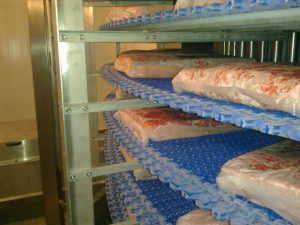
-
Layout of the production area
-
Environmental and hygienic conditions
-
Required construction material
-
Product dwell time on the belt
-
Product type and throughput capacity
-
Product dimensions and weight
-
Integration with upstream and downstream equipment
-
Number of tiers
-
Drum diameter
-
Belt type and belt width
-
Tier height
-
Direction of belt winding (clockwise or counterclockwise)
-
Arrangement and length of infeed and outfeed sections
-
Infeed and discharge heights
-
Drum rotation speed
Typical Applications in the Food Industry
For food-industry applications, spiral conveyors are designed in accordance with hygienic design principles. Modular belts and structural materials are selected to support effective cleaning, reliable operation, and compliance with food safety requirements.
Hygienic and Safety Design
Operational safety is ensured by emergency stop devices and visual signaling systems integrated into the conveyor control.
-
Shock freezing systems
-
Cooling of bakery products after baking
-
Gentle lifting or controlled descent of products
-
Product buffering and accumulation
Spiral conveyors provide a reliable, space-saving, and hygienic solution for vertical product transport in modern food-processing lines.